
Mental health stigma arises from the negative attitudes and actions towards someone who is struggling with their mental wellness. It can lead to feelings of shame and hopelessness. Stigma is one of the main reasons that a person may not choose to seek help, which could then worsen their condition. Although mental health is discussed more openly now than in the past, mental health stigma continues to exist in many workplaces.
How could mental health stigma at work affect a person?
- They may be fearful that disclosing a mental health issue will impact their professional reputation, relationships with coworkers, and/or job security.
- They may have negative interactions at work and experience acts of discrimination.
- They may hide their symptoms and struggle through work tasks.
- They may turn to using substances to help them cope.
- They may choose to not express their needs to their coworkers or their supervisor, therefore not getting potentially helpful support that could enable them to thrive.
How could mental health stigma at work affect an organization?
- Stigma could influence coworkers to question that a mental health illness is valid and/or use language that attaches hurtful labels.
- The workplace may notice:
- increased absenteeism
- decreased productivity
- lower staff engagement
- lower job satisfaction
- employee retention issues
- challenges putting a psychological health and safety program in place.
Disrupting stigma in the workplace requires a sustained effort over time to shift the culture. We all have a role to play in breaking down the barriers that stigma creates. Our words and actions matter to ensure that everyone is treated with respect and dignity.
- Educate yourself about mental health
-
Education is the most powerful tool to address stigma. It can help build an understanding what mental illness is (and what it isn’t) and can help us examine our own personal beliefs.
- Check your internal biases. We can be influenced by the judgments of society, what we see in the media and the prejudices of our family and friends. Even someone who believes themselves to be open and understanding may hold different feelings subconsciously. Be aware of your own biases and recognize how they may influence your behaviours.
- Challenge myths and stereotypes. There are many myths and stereotypes that surround mental illness. Speaking up when you hear a misconception inaccurate gives a voice to those who are suffering in silence.
Common myths and facts about mental health:
MYTH: Mental illnesses aren’t real illnesses.
FACT: Mental illnesses create distress, don’t go away on their own, and are real health problems with effective treatments.MYTH: People with mental illnesses are violent and dangerous.
FACT: People who experience a mental illness are no more violent than people without one. They are actually much more likely to be victims of violence than be violent themselves.MYTH: Mental illnesses are just an excuse for poor behaviour.
FACT: Sure, some people with a mental illness may act in ways that seem strange to others. But, it’s the illness behind these behaviours, not the person, and they may feel quite embarrassed or ashamed about them.MYTH: People don’t recover from mental illnesses.
FACT: People can and do recover from a mental illness. There are many different treatments, services, and supports to help people who experience mental illness to lead productive and engaged lives.MYTH: People who experience mental illnesses can’t handle stress.
FACT: Stress impacts well-being, but this is true for everyone. People who experience mental illnesses may actually be better at managing stress because they have learned to manage it and problem-solve before it affects their well-being.MYTH: People who ask for help in dealing with a mental illness are weak.
FACT: Asking for help when you need it is a sign of strength, not weakness.MYTH: People who experience mental illnesses can’t work.
FACT: A mental illness does not mean that someone is not capable of working. Some people benefit from changes at work to support them, but many people work with few supports from their employer. Most people who experience serious mental illnesses want to work but face barriers to finding and keeping meaningful employment. - Choose your words wisely
-
Be mindful that the language you use in daily conversations can reinforce stigma. Choose your words carefully towards using positive person-centred language that avoids labeling a person.
- Instead of “this is driving me crazy”, say “this bothers/annoys/frustrates me”.
- Instead of “this is nuts”, say “this is interesting/peculiar/funny”.
- Instead of “they suffer from depression”, say “they live with/experience depression”.
- Instead of “they are insane”, say “they live with a mental illness”.
- Instead of “committed suicide or failed suicide”, say “died by suicide or attempted suicide”.
- Instead of “substance abuse”, say “substance use” or “substance use disorder”.
- Instead of “they were an addict”, say “they are in recovery”.
Source: Mental Health Commission of Canada Language Matters Cheat Sheet
- Have open conversations about mental health
-
- Create a culture where it’s safe to speak freely about mental health to help build trust and understanding between all workers in the organization. This also acknowledges that mental health is an important part of a person’s’ overall wellbeing.
- Leaders (formal and informal) can help to foster a supportive environment where employees feel comfortable to take care of their own mental health. This can help a person who is struggling to feel less isolated.
- Support your coworkers
-
- Invite a conversation if you notice that someone doesn’t seem themselves lately. Or if someone comes to you seeking to talk, listen with compassion. Resist offering advice and ask what you can do to help. Encourage them to take next steps when they are ready. Be sure to align seeking help as a sign of strength, not weakness.
- Share resources of services that offer additional support, such as a benefits program, Employee Assistance Program, community counseling services, etc. See the Mental Health Support page for a comprehensive list of mental health service providers.
- For additional information on supporting coworkers, visit Workplace Strategies for Mental Health - Supporting Troubled Coworkers.
Substance use and stigma in the workplace
Mental health and substance use are closely intertwined. The workplace can be an important place for a person to get support with a substance use issue. As mentioned above, eliminating the stigma associated with a mental health concern, including substance use, is important for an employee to feel comfortable seeking help. Learn more about substance use and stigma on the Stop Stigma page.
- Is substance use affecting your life? Visit the Mental Health Support page for helpful service providers.
Free resources
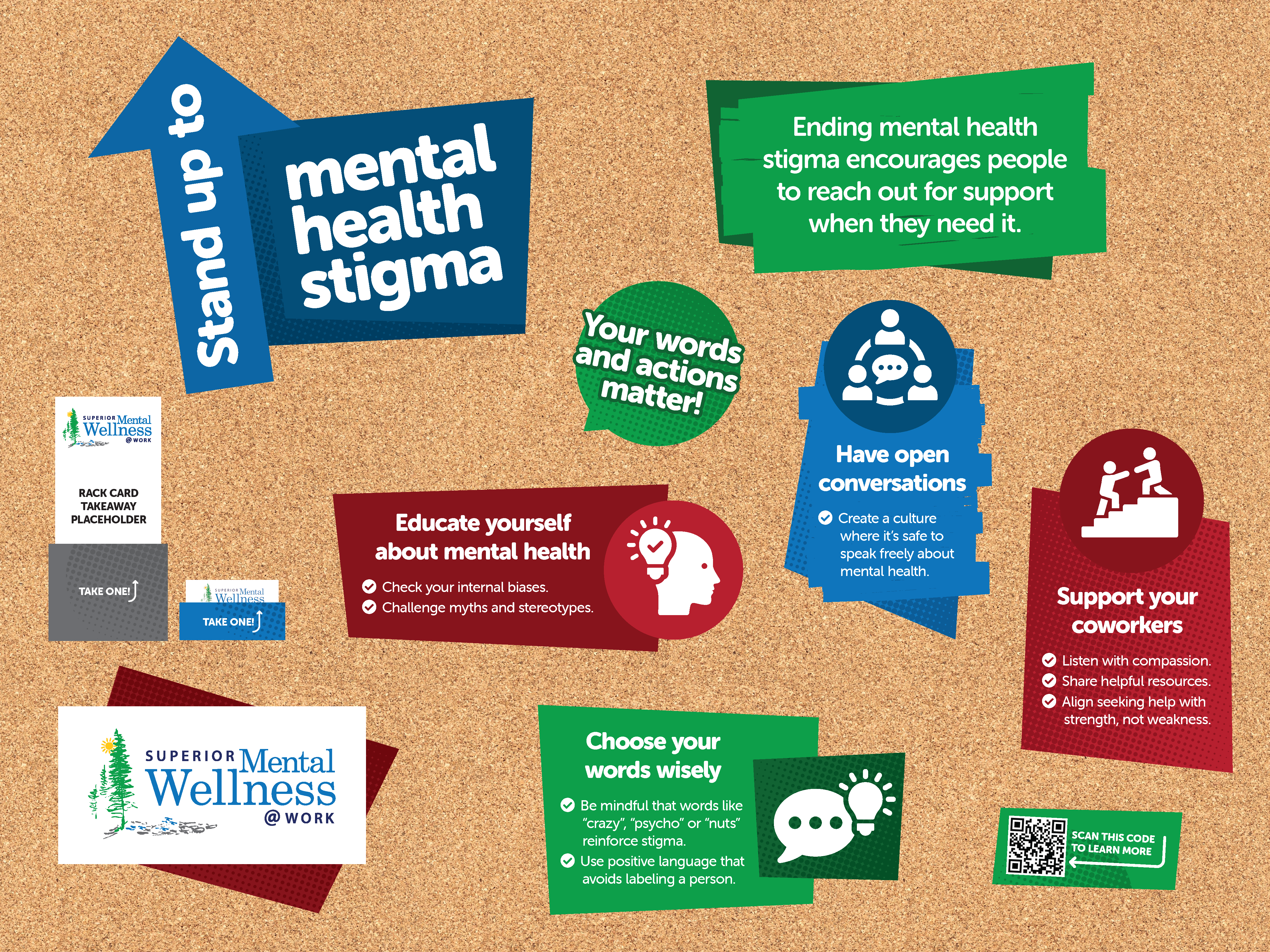
TBDHU offers various free resources to promote positive mental wellness in the workplace. This includes a "Stand Up to Stigma" bulletin board kit. Check out all of the available resources on the SuperiorMentalWellnessAtWork page.
Helpful links
- Get Real Photovoice anti-stigma in the workplace campaign
- Addressing Stigma: Centre for Addiction and Mental Health
- Recognizing and Addressing Stigma at Work: Canadian Centre for Occupational Health and Safety
- Checklist for Workplace Policies on Substance Use Stigma: Canadian Centre on Substance Use and Stigma