
Ticks are Present in Thunder Bay and District
The City of Thunder Bay and immediately surrounding area are considered a risk area for Lyme disease.
Lyme disease is caused by a bacterium called Borrelia burgdorferi, which is spread through the bite of infected blacklegged ticks. Infected blacklegged ticks need to be attached for at least 24 hours in order to transmit the bacteria that causes Lyme disease.
Most ticks found in the Thunder Bay District are wood ticks and do not carry the Lyme disease bacteria. Visit our Lyme Disease fact sheet page for more information.
To reduce the risk of a tick bite and reduce the risk of Lyme disease, read on to learn more/
- Prevent the Bite
-
Ontario’s Ministry of Health encourages residents to:
- COVER UP: Protect yourself when you are active outdoors; wear closed foot wear and long sleeves, tuck pants in socks and wear light coloured clothing so ticks are more easily noticed
- USE BUG SPRAY: Follow the directions and use bug spray containing DEET or Icaridin on exposed skin to keep bugs away.
- CHECK YOURSELF & YOUR PETS: Do a tick check after being outdoors. Look in warm, hidden areas on the body including armpits, in and around the hair and ears, between the legs, and the back of the knees. Use a mirror or have someone else check the back of your body for you. Don’t forget the family pet; in and around the ears, on the belly and between the toes. A Tick Check Zone poster (PDF) provides ideas on where to look on a human and a dog.
- PROTECT YOUR PETS: Ask your veterinarian about options to help keep ticks off your pets.
- Know the Tick
-
The Don't Get TICKED Outdoors Poster (PDF) includes images of both a wood tick and a blacklegged tick. Females are usually larger than the males and the size of each tick depends on the stage of the lifecycle; eggs to larva to nymphs to full-size adults.
Ticks can range in size from a poppy seed in the nymph stage to a pea when they are engorged (full of blood). Wood ticks are larger in size than the blacklegged ticks.
For example:
- a female wood tick is about 0.5 cm long
- a female blacklegged tick is about 0.3 cm long
Here is a photo of blacklegged ticks at different stages of feeding. The largest is filled with blood after feeding:
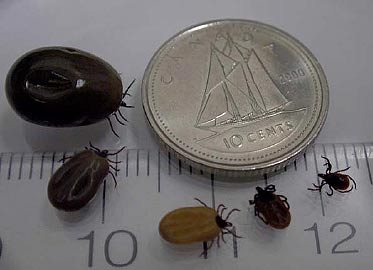
Source: Government of Canada Use these photos below to help you identify any ticks you might find:
Wood Ticks/ American Dog Ticks
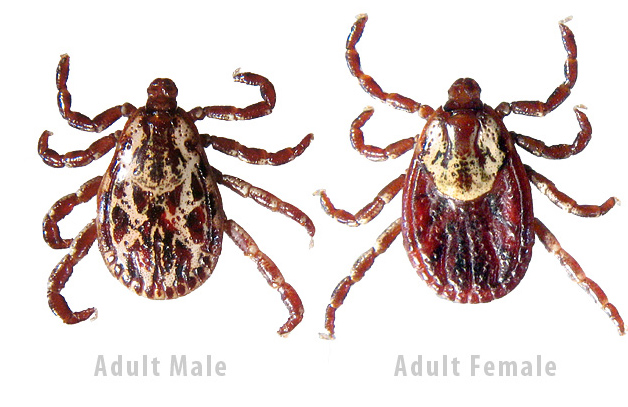
Photo credit: University of Rhode Island; TickEncounter Resource Centre (http://www.tickencounter.org/) Wood ticks OR American dog ticks are nuisance ticks
- Adult male - mottled brown-cream back/reddish brown legs
- Adult female - Brown body/cream cape/reddish brown legs
Blacklegged Ticks/ Deer Ticks
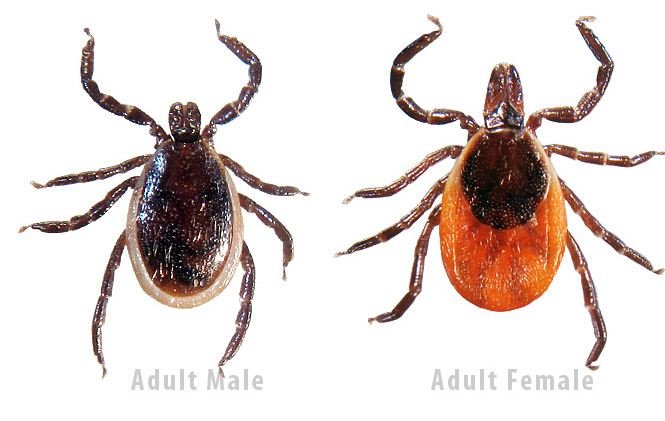
Photo credit: University of Rhode Island; TickEncounter Resource Centre (http://www.tickencounter.org/) Blacklegged ticks or deer ticks have the potential to carry Lyme disease
- Adult male - all black
- Adult female - reddish-brown body/black cape and legs
If you are unsure of the type of tick you have found, you can submit the tick for identification. More details are provided in the Submit the Tick section below.Engorged Ticks
It is also possible that the tick might be engorged when you find it. This means it is filled with blood after feeding. The photo below is an engorged female wood tick, found on a dog.
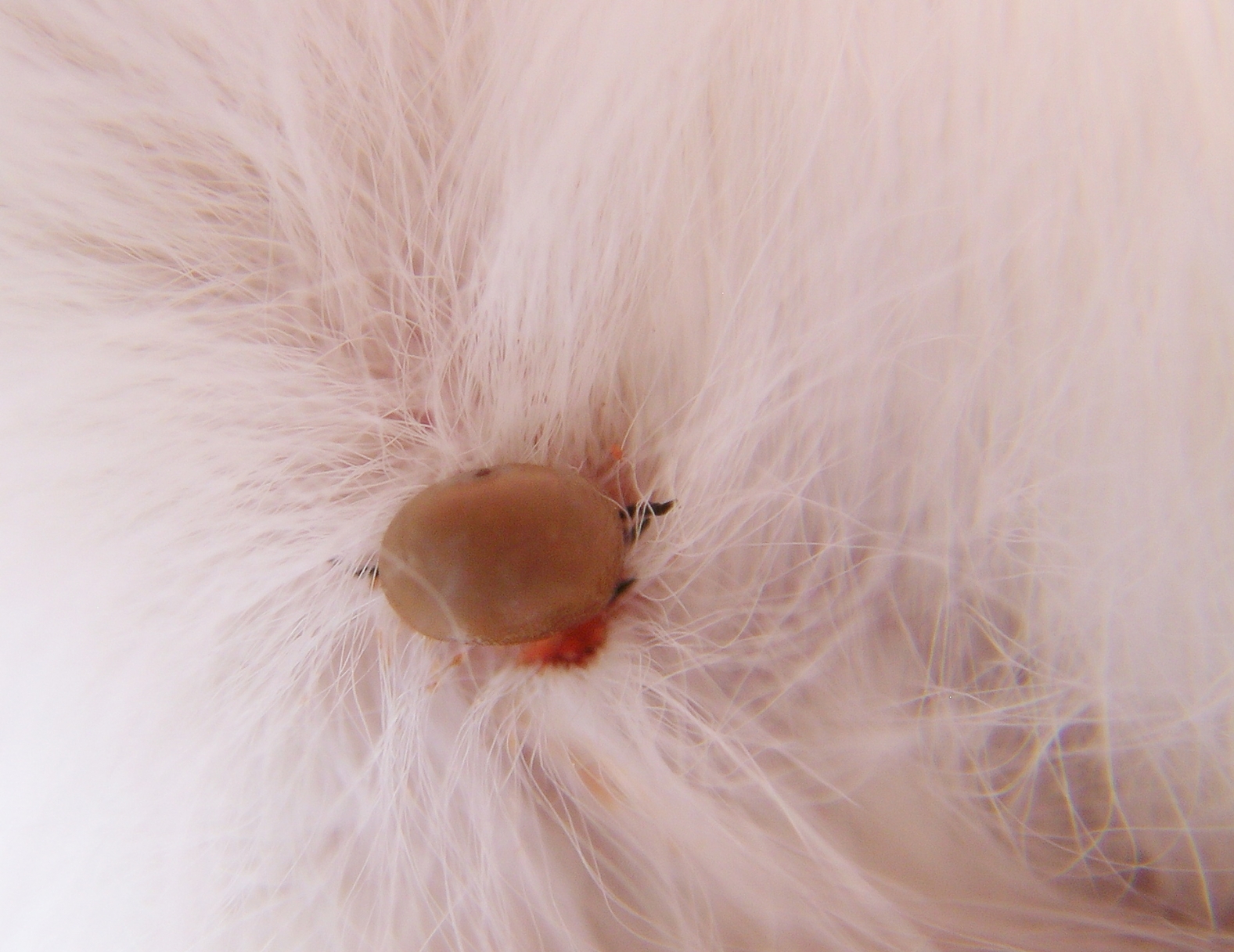
- Remove the Tick
-
Ticks bite, draw blood, enlarge and then drop off. The tick's mouth will be under the skin, but the belly will be sticking out. The TBDHU is no longer providing tick removal kits. You can make your own with a pair of fine-tipped tweezers and an alcohol pad in a plastic bag and place this in your first aid kit. You can also include a copy of the Tick Identification Wallet Card (PDF).
To remove the tick, follow these steps:
- Do not use a lit match or cigarette, nail polish or nail polish remover, petroleum jelly, liquid soap or kerosene to remove the tick.
- Ticks penetrate the skin with their mouthparts, draw blood, enlarge and then drop off. The feeding tick's mouth will be under the skin, but the abdomen will be sticking out.
- Use fine-tipped tweezers. Grab the head and mouth as close to the skin as possible.
- Pull up slowly until the tick is completely removed.
- Do not twist or turn.
- Put it in a clean container and mark the date and geographic location of where the tick was picked up.
- Wash the area with soap and water OR apply rubbing alcohol.
- Identify the tick.
- Identify the Tick
-
NOTE: Black-legged ticks submitted through passive surveillance (e.g. submitted by members of the public) are not tested for Lyme Disease bacteria. The decision was made by the National Microbiology Laboratory. Why? The guidance used by health care providers does not depend on testing the tick. Health care providers only need to know what type of tick it is.
So, if you have identified the tick read on to the next section of this webpage to learn what actions can be taken based on the type of tick.
Identify the tick yourself
- Use the photos provided on this webpage under the “Know the Tick” section above to identify the tick.
Submit to the online e-tick portal
- Submit a photo of your tick for identification through www.etick.ca after setting up an account. You will receive a message identifying your tick.
Visit the office in Thunder Bay
- Have the tick identified by TBDHU by putting the tick in a clean container, marking the date and geographic location of where the tick was picked up AND bringing it to the Thunder Bay District Health Unit (TBDHU) for identification from Monday to Friday, 8:30 am to 4:30 pm, 999 Balmoral St., Thunder Bay OR the nearest branch office in the district.
- Wait for a call from TBDHU. If you don’t hear back within a week, please call our office at 807-625-5930 or toll-free at 1-888-294-6630.
Call the nearest Health Unit office if you live in the district
- Calll your nearest TBDHU office in the district and follow the instructions given
- What to do if it's a wood tick
-
Monitor the bite for signs of infection and contact a health care provider with any concerns.
- What to do if it's a blacklegged tick
-
STEP 1: Contact TBDHU
Call (807) 625-5900 or toll-free at 1-888-294-6630 and ask to speak with a public health inspector.
Let them know you have come into contact with a black-legged tick and give them the geographic location of where you can into contact with the tick.
STEP 2: Do you have any signs or symptoms, like a “bulls-eye” rash around the tick bite
See here for a full list of signs and symptoms.
YES, I have signs or symptoms
Contact your doctor or nurse practitioner right away to discuss your options and let them know where you were when the blacklegged tick attached.
The window for treatment of early localized Lyme disease is 30 days, so don’t wait.
NOTE: If you visit a pharmacist and you have symptoms, they will refer you to a doctor or nurse practitioner.
NO, I don’t have any signs or symptoms
1) The tick attached in the City of Thunder Bay or immediately surrounding area.
We know from active surveillance (dragging for ticks) that over 30% of black-legged ticks in the City of Thunder Bay and immediately surrounding area are infected with the bacteria that causes Lyme disease and this area is considered a risk area (see here for a risk map of Ontario).
If you were bitten by a blacklegged tick in the Thunder Bay area, the health care provider will use one of the following algorithms to determine if post-exposure prophylaxis (a preventive dose of an antibiotic) medication is recommended.
- Doctors and nurse practitioners use this algorithm
- Pharmacists use this algorithm
If the tick was attached for less than 24 hours OR was removed more than 72 hours after it was attached, the post-exposure prophylaxis (a preventive dose of an antibiotic) is not recommended and the health care provider will recommend that you monitor for signs and symptoms for 30 days.
If you do experience any signs or symptoms during the 30 days, you should visit your doctor or nurse practitioner right away. Pharmacists will refer you to a doctor or nurse practitioner, as they cannot treat if you are showing signs or symptoms.
2) The tick attached when you were visiting an area outside of the City of Thunder Bay or immediately surrounding area.
Contact your health care provider and be prepared to discuss with them about the geographic location of where you were when the tick attached and how long the tick was attached to you before you removed it.
They will use this information and the algorithms listed above to determine if post-exposure prophylaxis (a preventive dose of an antibiotic) is recommended.
- The Health Unit is Monitoring the Tick Population
-
The percentage of blacklegged ticks In the City of Thunder Bay area infected with Borrelia burgdorferi (the causative agent of lyme Disease) is greater than 40%.
The TBDHU monitors the tick population through:
Passive Tick Collection
- Members of the public can bring ticks into the TBDHU (including District offices) for identification. See the section above, Identify the Tick for Identification.
Active Tick Collection
- The TBDHU uses “tick dragging” in different locations throughout the Thunder Bay District to try to document the extent of the black-legged tick range in our area.
For Further Information
Call the Environmental Health Program: (807) 625-5900 or Toll-Free 1 (888) 294-6630.