
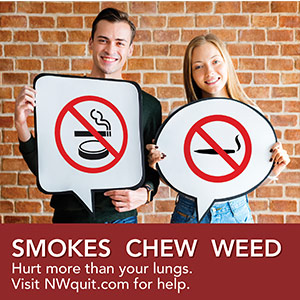
- Smokes
-
Smoking hurts more than your lungs. Smoking can cause many oral health problems, including:
- Inflamed gums and mouth tissue
- Tooth decay (cavities)
- Increased plaque
- Bad breath
- Stained teeth
- Decreased sense of smell and taste
- Sensitive teeth
- Oral and throat cancers
- Mouth sores or lesions that do not heal
Smoking tobacco can also lead to:
- Lung cancer
- Heart disease
- High blood pressure
- Premature wrinkles and hair loss
- Impotence
- Yellow fingers
- …and more!
- Chew
-
Chew, also known as dip, snuff, or spit tobacco, can cause many oral health problems, including:
- Oral and throat Cancers. Chew is one of the leading causes of oral cancer, as it contains many harmful chemicals that can cause cancer.
- Sensitive teeth
- Tooth decay (cavities)
- Decreased sense of smell and taste
- Bad breath and stained teeth
- Inflamed gums and mouth tissue
- Mouth sores that don’t heal
How can I protect my mouth from the effects of smokes and chew?
The best way to protect your health is to stop smoking. There are many ways to help you stop smoking – here are just a few:
- Find friends who want to stop smoking too! Most youth who smoke want to stop. Everything is better with friends.
- Reward yourself! Celebrate quitting milestones!
- Talk to a trusted adult (at home? at school? in the community?)
- Avoid places you will be tempted to smoke or think of something else to do (instead of smoking).
- Drink water, take deep breaths, and distract yourself to get through cravings You can also talk to your health care provider or dental care provider about quitting.
Other resources include:
- Break it Off, provides online support as well as a Facebook group and an app
- Smokers’ Helpline, online, text, or phone support to help you stop smoking
- NWquit.com provides supports for tobacco users in Northwestern Ontario who are ready to stop smoking
- Weed
-
Weed (inhaled cannabis), also known as marijuana, pot, hash, or dope, can cause many oral health problems, including:
- Dry mouth
- Increased tooth decay (cavities) from a decrease in saliva
- Sensitive teeth
- Damage to gums and other tissues
- Bad breath
- Sore or burning mouth
- Difficulty chewing, swallowing, and speaking
- Oral and throat cancers
- Inflamed gums
- Sores in your mouth that don’t heal
How can I protect my mouth from the effects of weed?
Smoking weed directly affects your lungs and mouth. Here are some safer ways to use cannabis:
- The only way to completely avoid the health effects of weed is by choosing not to use it.
- There are safer ways to use weed. Check out The Blunt Truth: Useful tips about safer ways to use cannabis for more great info!
- Try to avoid deeply inhaling or holding your breath when smoking weed to avoid absorbing more toxic materials.
- Try to limit your use as much as possible.
- Choose low-strength products, with lower THC (tetrahydrocannabinol) content.
Additional Resources
Contact the Health Unit Tobacco Program: (807) 625-5900 or toll-free at 1-888-294-6630
Smokes
- Canadian Dental Association: Smoking Tobacco
- Ontario Dental Hygienists' Association: Smoke & Smokeless Tobacco Factsheet (PDF)
- Centre for Addiction and Mental Health: Tobacco
- Canadian Dental Association: Oral Cancers
Chew
- Canadian Dental Association: Smokeless Tobacco
- Ontario Dental Hygienists' Association: Smoke & Smokeless Tobacco Factsheet (PDF)
- Centre for Addiction and Mental Health: Tobacco
- Canadian Dental Association: Oral Cancers
Weed
- 10 Ways to Reduce Risks to Your Health When Using Cannabis (PDF)
- The Blunt Truth: Useful Tips About Safer Ways to Use Cannabis (PDF)
- TBDHU: Cannabis
- Centre for Addiction and Mental Health: Cannabis
For Further Information
Contact the Oral Health Program at (807) 625-5900 (Thunder Bay) or toll-free 1-888-294-6630 (District).